Winter Porch Decor Ideas That Hold Up to Real Weather
By Jordan Ellis · Published · 5 minutes read
A winter porch can be the most inviting square footage on the house or the saddest, depending on what you put on it. The difference usually comes down to materials that tolerate freeze-thaw cycles, wind, and road salt — and to decorating in layers rather than placing one wreath and calling it done.
This guide covers fabrics and window treatments for glazed and screened porches, lighting that works in low winter sun, greenery that doesn't shed by January, and a realistic budget range for each element.
Start With the Envelope: Window Treatments for Cold Porches
If your porch is enclosed — screened, three-season, or fully glazed — treat the windows before you hang a single garland. Outdoor-rated roller shades in a solution-dyed acrylic or PVC fabric block wind and low sun, and they cost roughly $60–$150 per window in stock sizes. Mount them outside the frame so the fabric clears the sash and doesn't trap condensation against the glass.
For a more tailored look, consider flat Roman shades in a fade-resistant outdoor fabric. They stack tight to the header, which keeps sightlines clean on a small porch. If you're weighing the two styles, this comparison of Roman shades vs. roller shades covers the practical trade-offs for sun control and fabric wear.
On an open porch, side panels at the corners do the same job as a windbreak. Choose a mid-weight outdoor canvas or acrylic and hang them on a galvanized rod with a 1.5-inch clearance from the floor so snow and ice don't wick up the hem. Panels also soften the hard edges of siding and railings in photos and in person.
- Outdoor-rated fabric only: solution-dyed acrylic, PVC-coated polyester, or marine canvas
- Hang hardware at least 2 inches out from the frame to reduce condensation
- Keep hems 1–2 inches off the floor on open porches
- Rinse salt spray monthly; salt stiffens fabric and dulls hardware
Layer for Warmth: Textiles That Survive Freeze-Thaw
The fastest way to make a porch feel warm is to add textiles at three heights: floor, seat, and overhead. An outdoor rug in polypropylene handles snow melt and hose-down cleaning; expect $40–$200 for a 5x8. Look for a low, tight pile so chairs don't wobble and ice doesn't get trapped in the fibers.
On seating, use cushions rated for outdoor use with removable, washable covers, and bring them inside during hard freezes — foam cores crack when they freeze wet. Add a washable throw in acrylic or a wool blend on each chair. Avoid cotton outdoors in winter; it holds water and stays cold for hours.
Overhead, a fabric awning or a pair of canvas panels hung from the ceiling adds visual warmth without trapping moisture. If you want the layered look that designers use indoors, the same principles apply outside: this guide to laying window treatments explains how to combine a shade, panels, and a valance without clutter.
- Polypropylene or recycled PET rug: hose-cleanable, won't mildew
- Cushions with zip-off covers; store cores indoors below freezing
- Acrylic or wool-blend throws over cotton every time
- One overhead element (awning, panels, or a fabric swag) is enough
Lighting: Plan for Dark Afternoons and Long Evenings
Winter daylight is short and low, so a porch needs two lighting layers: task light near the door and ambient light for the seating zone. Battery LED string lights on a timer cost $20–$60 and need no wiring; look for IP44 or higher ratings and a warm 2700K color temperature, which reads cozy rather than clinical.
Lanterns with real candles are risky on a windy porch; flameless LED candles in glass hurricanes give the same glow with none of the maintenance. For the door, a hardwired sconce on a photocell or smart switch means the porch lights up at dusk without you thinking about it — useful when you arrive home in the dark.
Keep cords and battery packs out of snowmelt paths. Mount controllers under a rail or inside a covered box, and check batteries monthly; cold cuts alkaline battery capacity by roughly half at freezing.
- 2700K warm white LEDs for a cozy cast
- IP44 minimum for exterior fixtures and string lights
- Photocell or smart switch on the main door light
- Battery packs mounted high and dry, checked monthly
| Element | Best Material | Typical Cost | Cold/Wet Performance | Maintenance |
|---|---|---|---|---|
| Outdoor roller shade | Solution-dyed acrylic or PVC | $60–$150 per window | Good; blocks wind and low sun | Rinse monthly; wipe salt |
| Corner side panels | Marine canvas or acrylic | $80–$250 per panel | Good as windbreak; keep hem off floor | Spot clean; re-tension yearly |
| Outdoor rug | Polypropylene or recycled PET | $40–$200 (5x8) | Excellent; tolerates freeze-thaw | Hose, sweep snow |
| String lights | LED, IP44+, 2700K | $20–$60 | Good; batteries weaken in cold | Check batteries monthly |
| Wreath | Fresh cedar or faux mixed | $30–$120 | Fresh: 3 weeks; faux: seasons | Mist fresh; dust faux |
| Doormat | Coir over rubber | $20–$70 | Coir weak when wet; best covered | Shake; replace yearly |
Greenery and Natural Elements That Last Past January
Fresh evergreen boughs are beautiful for about three weeks in dry cold and less in sun and wind. To stretch them, condition boughs in water overnight before arranging, keep them out of direct sun, and mist occasionally. Cedar, pine, and magnolia hold up best; boxwood dries and yellows faster in wind.
For a no-maintenance option, mix fresh boughs with faux stems in the same arrangement — the eye can't tell at three feet. Urns and planters should be frost-proof (stone, fiberglass, or thick plastic), and if you fill them with soil, expect freeze-thaw heaving to push plants up; a layer of gravel and a liner solves most of it.
Add natural texture beyond greenery: birch logs, dried hydrangeas, pinecones, and burlap ribbon. Group them in odd numbers and vary heights by at least 6 inches so the arrangement reads at a glance from the street.
- Condition boughs in water overnight before arranging
- Cedar and magnolia outlast boxwood in wind
- Mix fresh and faux stems for longevity
- Frost-proof planters with gravel drainage and a liner
Color, Door Decor, and the Entry Moment
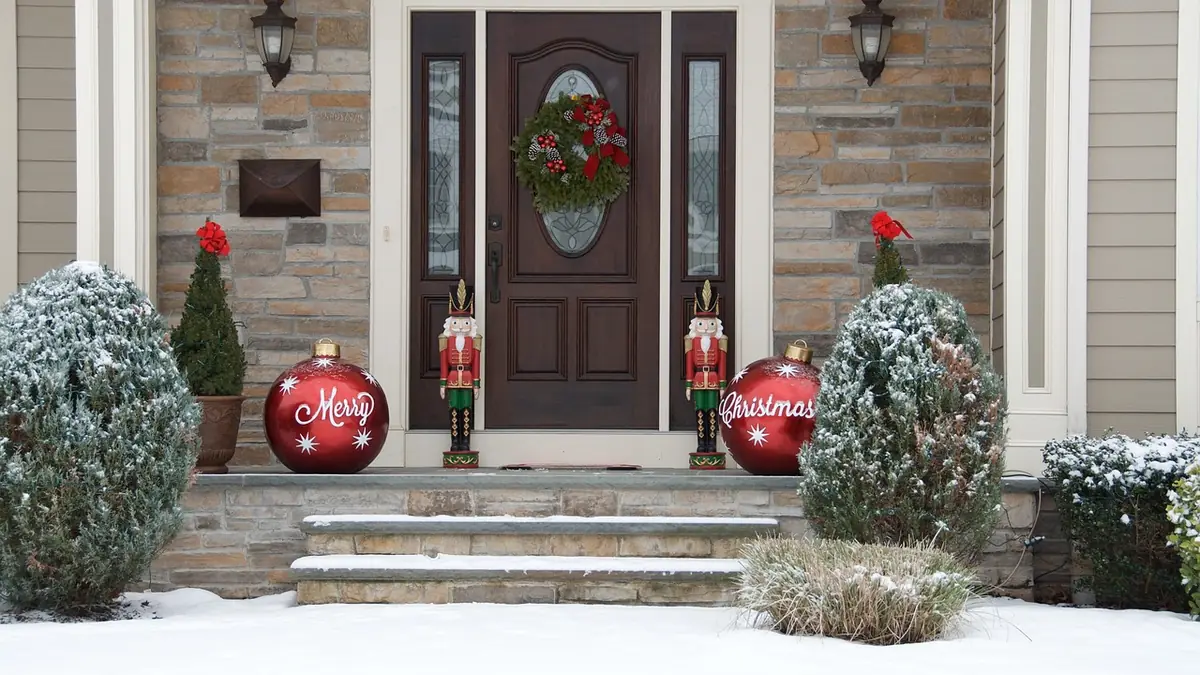
Winter palettes work best with restraint: two or three colors plus natural browns. Deep green with black hardware, or a soft white with warm wood tones, both photograph well against gray siding. If your door is dark, choose a wreath with light elements — eucalyptus, white berries, or a pale ribbon — so it doesn't disappear.
Wreaths should be sized to the door: roughly one-third the door's height reads as balanced, so a 20–24 inch wreath suits a standard 80-inch door. Hang from a proper hanger rather than a nail, and check that the wreath clears the storm door swing.
A doormat is the cheapest upgrade with the biggest effect. Layer a natural coir mat over a rubber scraper mat; coir handles dry cold but degrades when constantly wet, so a covered porch is its best home.
- Two or three colors plus natural browns
- Wreath about one-third the door height (20–24 in typical)
- Coir over rubber scraper mat, best under cover
- Check clearance for storm doors and screen doors
Safety, Weatherproofing, and Budget
Anything that hangs — shades, panels, garlands, lights — needs to be anchored into framing, not siding. Use exterior-rated stainless or galvanized fasteners; standard zinc screws rust and stain within a season near salt air. Cords should never cross walkways or hang where snow slides off the roof could tear them down.
If you have children or pets, treat looped cords on porch shades as a hazard and choose cordless or motorized lift options. The same rules that apply indoors are covered in this piece on child safety and window treatments, and they matter just as much on an enclosed porch.
Budget realistically: a modest refresh (rug, throw, two lanterns, wreath) runs $150–$400; adding outdoor shades to four windows or hanging panels at the corners adds $300–$1,200 depending on size and fabric. Buy hardware once and buy good; it outlasts three sets of cheap brackets.
- Anchor into framing with stainless or galvanized fasteners
- Keep cords clear of walkways and roof-shed zones
- Choose cordless or motorized lift where kids or pets are present
- Expect $150–$400 for a refresh; $300–$1,200 to add shades or panels
- Treat the windows and corners first; shades and panels do more for comfort than any accessory.
- Choose outdoor-rated fabrics and hardware — acrylic, polypropylene, stainless — and keep hems off wet floors.
- Plan lighting in two layers with warm 2700K LEDs and IP44 ratings for exterior use.
- A realistic refresh runs $150–$400; adding shades or panels pushes the total to roughly $300–$1,200.
Jordan Ellis is the editor of NSWindowTreatments, with years of experience in home decor and window fashion. He is passionate about helping homeowners make informed decisions about window treatments that enhance both style and functionality.