Design Studio Roller Shades: Customization and Light Control
By Jordan Ellis · Published · Updated · 4 minutes read

Design Studio roller shades sit in the middle of the roller shade market: more fabric choices, wider sizing and cleaner hardware than off-the-shelf rollers, without the price of a fully bespoke couture line. They are a popular pick for living rooms, bedrooms and home offices where a simple, flat shade suits the architecture.
This guide covers how the line is typically built, how fabric opacity changes the light in a room, which hardware and lift options matter in daily use, and roughly what to budget per window.
How the Design Studio Line Is Built
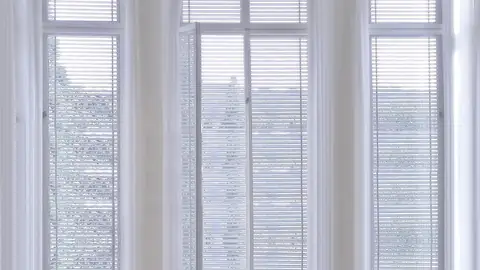
Design Studio roller shades are made to order. The fabric is cut to your measured width, wrapped on a metal tube and fitted with a clutch or motor at one end. Because they roll from the top down, the shade stacks into a compact roll at the headrail rather than folding into pleats, so the window keeps a flat, architectural look.
Most fabrics in the line are woven synthetics, linens and blends in the 8 to 14 ounce per square yard range, which is heavy enough to hang straight and resist curling at the edges. Roller shades are available in a large number of weaves and colours, which is the main reason people choose this line over stock shades.
Two measurements drive everything: exact inside-mount width and drop length. Measure to the nearest 1/8 inch at three points across the window and use the narrowest figure. If you are unsure, this step-by-step measuring guide walks through inside versus outside mounts.
- Made-to-order widths, commonly from about 12 inches up to 96–108 inches depending on fabric
- Maximum drop usually 84–96 inches; wider shades may require a heavier tube
- Fabric roll diameter grows with drop length, so deep windows need more clearance above the glass
- Inside mount needs roughly 1 1/2–2 1/2 inches of flat mounting surface at the head
Fabric Opacity and Light Control
Opacity is the single biggest decision. Sheer and light-filtering fabrics let roughly 30–60 percent of visible light through while softening glare and preserving a view. Room-darkening fabrics block most light but usually show a soft glow at the edges; blackout fabrics with a coated backing get closer to full darkness but rarely reach 100 percent without side channels.
For bedrooms, pair a room-darkening roller with an outside mount that overlaps the window opening by 2–3 inches per side and 3–4 inches at the top. That overlap, not the fabric alone, is what kills the light halo. A dual-shade setup, with a blackout roller behind a sheer, gives you flexibility without changing hardware.
If privacy during the day matters more than darkness, look at light-filtering weaves in the 3–5 percent openness range. They keep the room bright while blocking sightlines from the street after dusk. For a broader comparison of how shade types handle heat and glare, see this guide to energy-efficient window treatments.
- Sheer: view retained, minimal privacy, glare reduced
- Light filtering: soft daylight, daytime privacy, some evening privacy
- Room darkening: 90–95 percent light block with proper overlap
- Blackout with side channels: closest to full darkness
| Opacity | Light through fabric | Daytime privacy | Night privacy | Typical rooms |
|---|---|---|---|---|
| Sheer | 50–70% | Low | None | Living rooms, view windows |
| Light filtering | 30–50% | Moderate | Low to moderate | Offices, kitchens |
| Room darkening | 5–15% | Moderate | Good | Bedrooms, media rooms |
| Blackout with side channels | Under 5% | Moderate | Very good | Bedrooms, nurseries |
| Dual (sheer + blackout) | Varies by layer | High | High | Bedrooms with daytime views |
Hardware, Valances and the Finish
Roller shades are judged partly by what you see at the top of the window. Design Studio shades typically offer a fabric-wrapped cassette or a metal fascia that hides the roll, plus open-roll options for a minimal look. A cassette adds roughly 2 1/2 to 3 1/2 inches of height at the headrail, so check clearance under trim or a curtain rod.
Chain-and-clutch lift is the standard and the most economical. Continuous loop chains are available in metal or plastic, and cord tensioners keep the loop taut for homes with children. Motorized versions use a rechargeable battery tube or low-voltage wiring and add convenience on wide or hard-to-reach windows.
For a fully finished look, many people layer a roller with drapery at the sides. If you are planning that, read the drapery measuring and installation checklist before you order so the stack-back and return clear the shade's cassette.
- Fabric-wrapped cassette or metal fascia to conceal the roll
- Chain-and-clutch, continuous loop, or motorized lift
- Cord tensioner devices for homes with children or pets
- Optional hold-down brackets for doors and tilt-in windows
Where These Shades Work Best
Flat roller shades suit modern, transitional and minimalist rooms, and they are unusually good at solving awkward windows: narrow sidelights, doors, sloped glazing and wide banks of glass where curtains would look heavy. In a home office, a light-filtering roller tames screen glare without darkening the room.
In kitchens and bathrooms, choose a wipeable synthetic weave and an inside mount to keep the fabric clear of splashes. For bedrooms, go room darkening with generous overlap. Rollers are also the easiest shade to motorize economically, which matters on tall or wide windows you cannot comfortably reach.
One limitation: a single roller covers one opening. For very wide spans, plan two or three shades side by side on separate brackets rather than one oversized roll, which can sag in the middle over time.
- Living rooms and home offices: light filtering or sheer
- Bedrooms: room darkening with 2–3 inch overlap
- Kitchens and baths: wipeable synthetics, inside mount
- Doors and sidelights: narrow widths with hold-down brackets
What to Budget
As a working range, a made-to-order Design Studio roller in a standard fabric typically runs about $150 to $350 per window for a mid-size opening with a basic cassette. Motorization commonly adds $150 to $400 per shade depending on the system and whether wiring is needed. Very wide shades and premium weaves push the upper end.
Those figures are for the shade alone. Professional measuring and installation, plus any drapery layering, changes the total considerably. Our price guide for custom window treatments breaks down where the money actually goes so you can compare quotes fairly.
- Standard roller with cassette: roughly $150–$350 per window
- Motorized lift: add about $150–$400 per shade
- Wide spans and premium fabrics: upper end of the range
- Installation and drapery layering priced separately
- Opacity and overlap matter more than brand claims for real darkness.
- Room-darkening shades need 2–3 inches of side overlap to work well.
- Motorization adds roughly $150–$400 per shade but pays off on wide or tall windows.
- Measure inside mount at three points and use the narrowest figure.
Jordan Ellis is the editor of NSWindowTreatments, with years of experience in home decor and window fashion. He is passionate about helping homeowners make informed decisions about window treatments that enhance both style and functionality.